Improving Biostasis Nomenclature: Straight Freezing

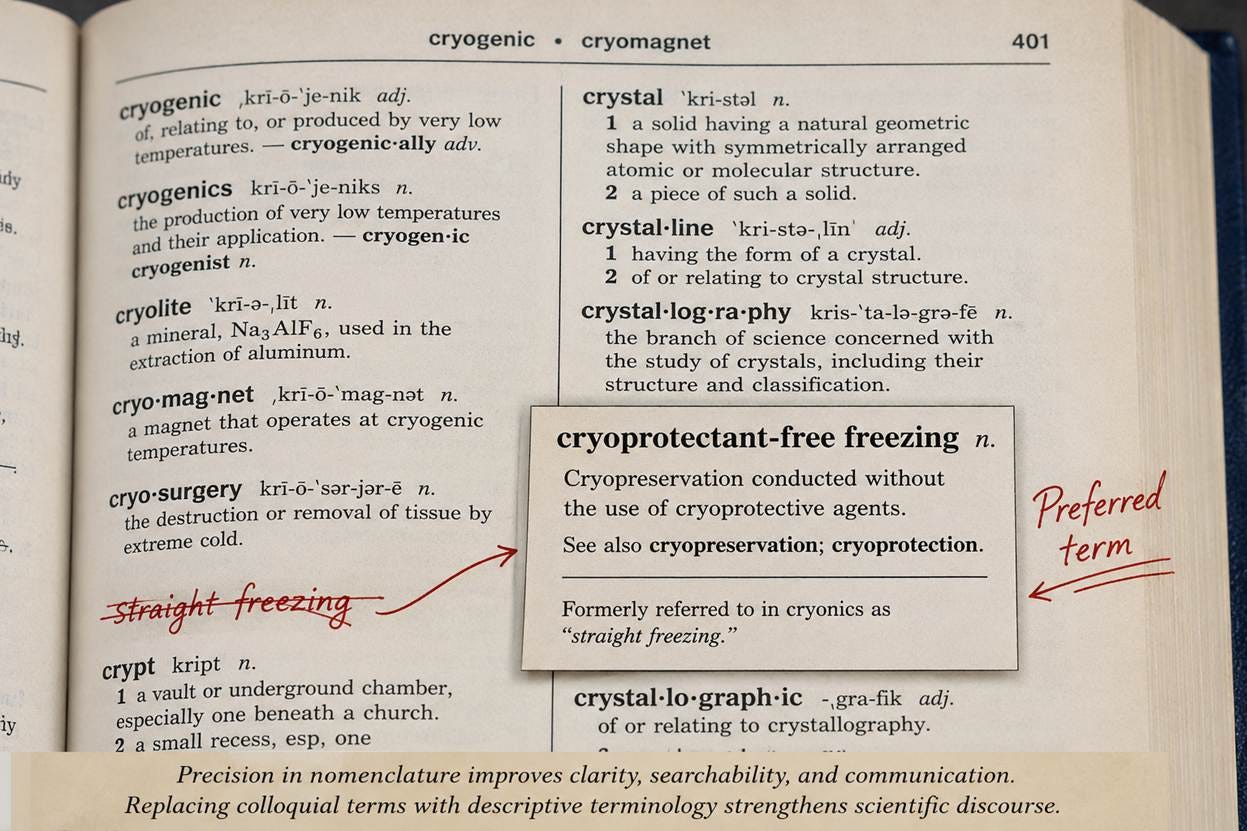
I have been intimately involved in cryonics since 1968, yet I have no memory of when or how the term “straight freezing” came into use. I do not have OCR versions of early cryonics publications such as the Life Extension Society newsletter, Freeze-Wait-Reanimate, the Cryonics Society of New York’s Cryonics Reports/Immortality, or the Cryonics Society of Michigan’s The Outlook/The Immortalist. Consequently, I can only search for the term in Cryonics magazine, where the earliest occurrence I have found appears in July 1984, in my review of Greg Fahy’s scientific presentation on brain cryopreservation (Darwin, 1984). I know the term was in general use long before this time, and my use of it without explanation in describing Fahy’s presentation appears to confirm this. It next appears in an article discussing possible low-cost options for cryopreservation, where, again, the context assumes general familiarity with the term (Darwin, 1985).
“Straight freezing” is a cryonics term rather than a term of art in cryobiology. As such, it has several drawbacks. The phrase is colloquial rather than descriptive, and it does not explicitly identify what distinguishes the procedure from other forms of cryopreservation. It may also be ambiguous to readers outside the cryonics community, who may reasonably ask, “straight” as opposed to what? Additionally, the term is not readily searchable in the cryobiology literature, limiting its usefulness in scientific communication and interdisciplinary discourse.
In my own unpublished scientific writings, I long ago switched to the term “uncryoprotected freezing” (UCP). However, I think that term is less than optimum because it is linguistically awkward. The combination of the heavy prefix “un-” with a long technical word creates a brief processing hitch for the reader, forcing the brain to decode the positive concept before applying the negation. As a result, alternatives such as “non-cryoprotected freezing” or “cryoprotectant-free freezing” (CFF) are generally cleaner, flow better, and sound more natural in technical prose.
I have neither the authority nor the influence to determine the nomenclature of biostasis. Nevertheless, I want to suggest more professional, descriptive terminology, if only for my own use. Two other alternatives consistent with documented cryobiological literature are “cryopreservation without cryoprotection” (CWC) or “cryoprotectant-free cryopreservation” (CFC) (Isachenko et al., 2004; Ong et al., 2022; Wang et al., 2022).
One scientist who reviewed a draft of this article preferred “uncryoprotected freezing.” Another pointed out that the acronym CFC is already widely known for chlorofluorocarbons, making the alternative “cryoprotectant-free freezing” (CFF) a better choice. Whatever terminology is ultimately chosen, replacing the colloquial and somewhat opaque “straight freezing” seems advisable.
References
Darwin, M. (1984, July). Lake Tahoe Life Extension Festival: A great weekend! Cryonics, Issue 48, 8–17.
Darwin, M. (1985, March). Reduced cost suspension option being considered. Cryonics, 6(3), 8–9.
Isachenko, V., Isachenko, E., Katkov, I. I., Montag, M., Dessole, S., Nawroth, F., & van der Ven, H. (2004). Cryoprotectant-Free Cryopreservation of Human Spermatozoa by Vitrification and Freezing in Vapor: Effect on Motility, DNA Integrity, and Fertilization Ability. Biology of Reproduction, 71(4), 1167–1173. https://doi.org/10.1095/biolreprod.104.028811
Ong, J. W., Song, Z., Abid, H. A., Lin, E. S., Liew, O. W., & Ng, T. W. (2022). Cryoprotectant-free preservation of bacteria using semi-spherical drops. Cryobiology, 104, 98–101. https://doi.org/10.1016/j.cryobiol.2021.11.179
Wang, M., Todorov, P., Wang, W., Isachenko, E., Rahimi, G., Mallmann, P., & Isachenko, V. (2022). Cryoprotectants-Free Vitrification and Conventional Freezing of Human Spermatozoa: A Comparative Transcript Profiling. International Journal of Molecular Sciences, 23(6), 3047. https://doi.org/10.3390/ijms23063047
Freeze Wait Reanimate (ocr’ed) is on the archive: https://archive.org/details/freeze-wait-reanimate
The term ‘straight’ appears 5 times, as far as i can tell, and none with ‘freeze’. (I suppose though that there could be errors in the OCR.)
Totally agreed. By the way, other terms we have used are "unprotected cryopreservation" https://www.frontiersin.org/journals/medical-technology/articles/10.3389/fmedt.2024.1400615/full or "freezing without cryoprotectants" https://pmc.ncbi.nlm.nih.gov/articles/PMC11753176/. I don't like "unprotected cryopreservation" as much anymore because it is unclear what would be doing the protection -- and anyway all tissues that I know of would likely have some sort of "protection". Another problem is that we are really talking about without adding exogenous cryoprotectants because tissues also (of course) have endogenous ones. Which then brings up questions such as what do you say about organisms that slowly build up endogenous cryoprotectants over time, there is the question of at what point in this process do you consider it a form of cryopreservation with vs without cryoprotectants. It would be nice to have a term for which it was easier to describe this spectrum.
Edited to Add: After thinking about it for a couple of minutes, my preferred term might be "cryopreservation without exogenous cryoprotectants" (CWEC).